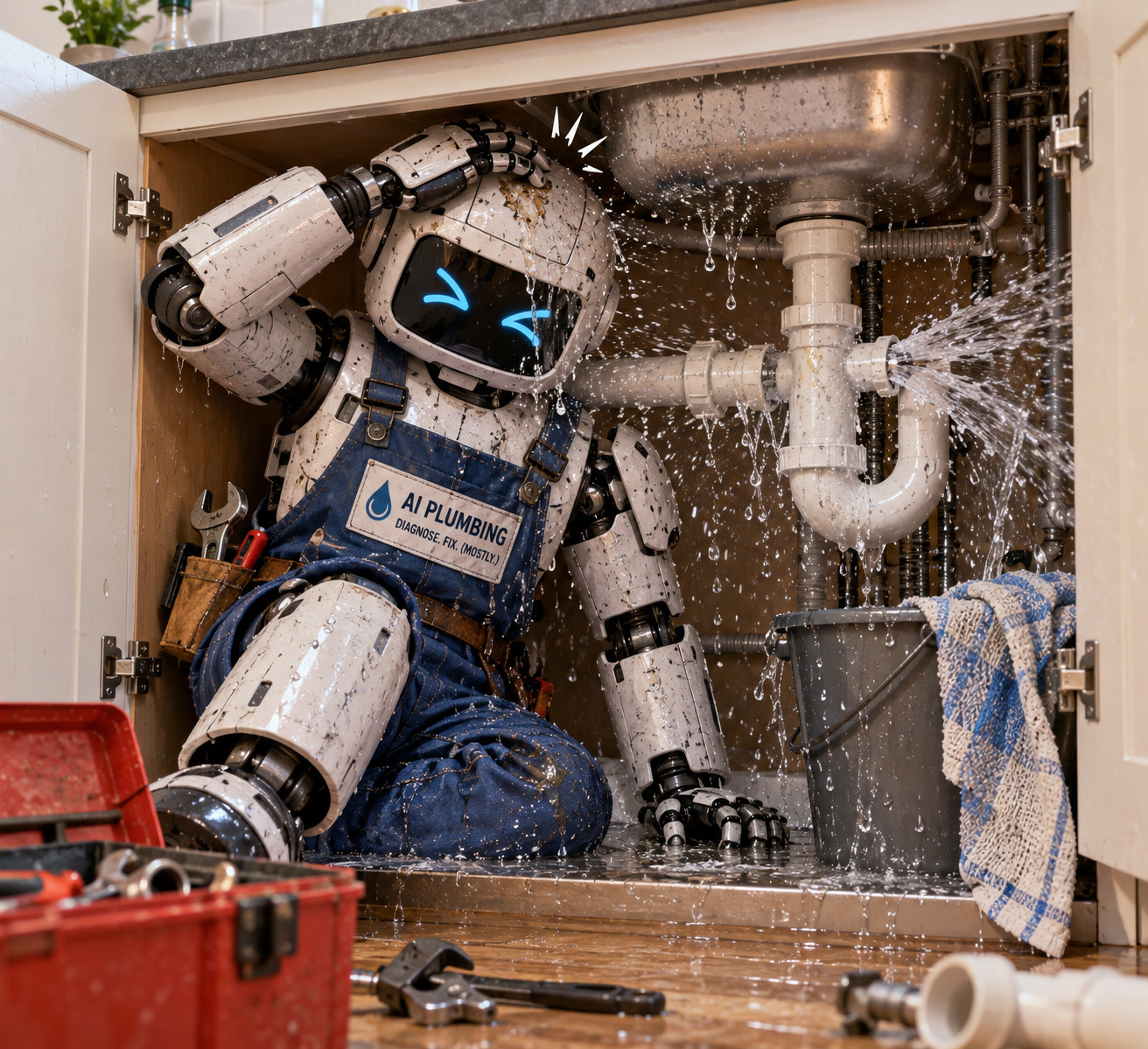
Whenever the subject of AI and jobs comes up, somebody will inevitably say something along the lines of …
Well, at least plumbers are safe.
And I understand the argument.
Chatbots can write code, produce marketing copy, analyse spreadsheets, draft legal documents and create images. But they can’t crawl underneath your kitchen sink with a spanner and, having watched some of the Robot Olympics this year, it looks like they won’t be able to for a while yet!
So plumbers, electricians, carpenters and other tradespeople are supposedly sitting pretty while the rest of us knowledge workers nervously wonder what our jobs are going to look like in five years’ time.
I’m not convinced.
And, amusingly, it was a conversation with my brother-in-law … who is a plumber … that made me realise why.
My plumber no longer needs a web developer
My brother-in-law is a self-employed plumber in Epsom.
When I saw him last Christmas he proudly informed me that he didn’t need me to help him with his website any more.
He’d got ChatGPT to do it.
As somebody who builds websites for a living, I suppose I could have been offended. But this was my brother-in-law. I wasn’t exactly losing a lucrative contract!
If anything, I was impressed.
Something he would previously have needed my knowledge and experience to do was now something he could have a reasonable crack at himself, with an AI talking him through it.
Fair enough.
But I had a story for him too.
This web developer no longer needed a plumber
For ages I’d had a problem with my central heating. One particular radiator simply wouldn’t get properly hot.
And it wasn’t for lack of professional advice.
We’d had three local, supposedly expert, plumbers look at it. One from Bexhill-on-Sea, one from Hastings and one from Ore.
The proposed solutions became increasingly expensive …
Two suggested fitting a more powerful “industrial” pump.
One suggested a power flush.
There was even a suggestion that the troublesome radiator needed moving onto its own flow and return circuit!?
Not one of them suggested balancing the system.
Not one.
The costs being discussed were all heading towards £1,000 or more.
So instead I discussed the problem with ChatGPT.
I explained the symptoms. We went through how the heating behaved. We experimented with the other radiators and gradually worked through balancing the system.
And it worked.
Not perfectly. There’s still room for improvement.
But the radiator that previously stayed cold now gets hot.
Cost: £0.
Three separate plumbers had somehow failed to spot that three older radiators and a new towel rail were hogging all the flow.
Suddenly my brother-in-law’s story about building his own website had a rather nice counterpart.
The plumber had used AI to avoid needing a web developer.
The web developer had used AI to avoid paying a plumber.
But ChatGPT can’t fix a leaking pipe
No. It can’t.
And this is where I think the usual discussion about which jobs are “safe from AI” starts to go wrong.
We keep asking questions like …
- Can AI replace a web developer?
- Can AI replace an accountant?
- Can AI replace a solicitor?
- Can AI replace a plumber?
But a job isn’t one indivisible thing. It’s a collection of tasks.
A plumber’s job isn’t simply “doing plumbing“.
It includes diagnosing faults, deciding what needs replacing, suggesting solutions, explaining how systems work, identifying likely causes and, quite importantly, deciding whether something actually needs physical intervention at all.
AI doesn’t need to replace the plumber to affect the plumbing industry.
It only needs to help customers do some of those tasks themselves.
The first casualty could be the call-out
Imagine you’ve got a radiator that doesn’t heat properly.
Ten years ago your options were fairly limited.
You could Google it, wade through forum posts, watch a collection of YouTube videos or call somebody who knew about central heating.
Today you can have an actual conversation with an AI.
You can tell it what boiler you’ve got.
Explain exactly what the system is doing.
Show it photographs.
Give it temperature readings.
Tell it what you’ve already tried.
And it can ask questions back.
“Does the inlet pipe get hot?”
“What happens if you close the other radiators?”
“Is the lockshield valve open?”
“Have you bled it?”
And, crucially, its next suggestion can depend on your answer.
That’s fundamentally different from finding a webpage called 10 Reasons Your Radiator Isn’t Getting Hot.
It’s much closer to having somebody knowledgeable standing beside you while you investigate the problem.
Sometimes the conclusion will still be …
You need a plumber.
But sometimes it won’t.
And every time it isn’t, that’s potentially one fewer paid job for a plumber.
AI doesn’t have to hold the spanner
This is the bit I think people underestimate.
AI doesn’t need hands to disrupt a job that involves hands.
Suppose AI helps a homeowner establish that their problem is a £12 valve rather than a £1,200 system flush.
They might still employ a plumber to replace the valve.
But instead of paying somebody to investigate the fault, diagnose it, try various solutions and then carry out the repair, they’re employing them for a much narrower task …
“Please replace this valve.”
The plumber hasn’t disappeared.
But the amount of plumbing expertise the customer needs to buy has shrunk.
And in plenty of cases, particularly for reasonably competent DIYers, AI may guide them through doing the simple jobs themselves.
That’s disruption.
And it won’t just affect plumbers
The same applies to loads of practical jobs supposedly protected from AI.
A carpenter may still need to cut and fit the timber, but AI can help the homeowner work out what timber they need, produce a cutting list and explain how to build something themselves.
A mechanic may still need to replace the failed component, but AI can help the owner interpret symptoms, understand an error code and question whether an expensive repair is actually necessary.
An electrician may still be essential for anything dangerous, regulated or requiring proper professional competence, but AI can help a homeowner establish that their mysterious “electrical fault” is actually something much simpler before calling one.
There are obvious limits.
There are jobs where attempting DIY would be daft or dangerous.
There are regulations and certifications for good reasons.
And AI can absolutely be wrong … sometimes spectacularly so.
But none of that means AI needs to eliminate tradespeople before it has an economic effect on them.
It merely needs to reduce the number of occasions on which we need them.
The jobs that survive AI won’t necessarily stay the same
I think this is the mistake we’re making when we divide occupations into two camps …
“AI can replace this.”
“AI can’t replace this.”
The reality is probably much messier.
AI doesn’t have to replace 100% of a profession to completely change its economics.
Perhaps it removes 10% of the work.
Perhaps 20%.
Perhaps customers increasingly arrive having already diagnosed the problem.
Perhaps the easy call-outs decline while genuinely difficult jobs become a greater proportion of a tradesperson’s workload.
Perhaps the most valuable plumbers of the future aren’t simply the ones who can diagnose common problems, because every customer has an AI capable of helping with that.
Perhaps they’re the ones with the experience and physical skills to solve the difficult problems after all the obvious possibilities have already been eliminated.
That’s still a valuable profession.
It just isn’t an untouched one.
Nobody gets to declare themselves safe yet
I’m a web developer.
I’m under no illusion that AI isn’t going to change what I do.
It already has.
And my plumber brother-in-law building his own website with ChatGPT is a perfect little example of it.
But I think my radiator is an equally useful example in the opposite direction.
AI couldn’t come into my house.
It couldn’t turn the valves.
It couldn’t feel which radiator was warming up.
It couldn’t rebalance the heating system itself.
I could.
What AI did was give me enough knowledge and guidance to do something I would previously have paid an expert to figure out.
And that’s why I don’t buy the idea that plumbers are “safe from AI”.
The robot doesn’t necessarily need to come into your house and pick up the spanner.
Sometimes it just needs to tell you which spanner to pick up.
Leave a Reply